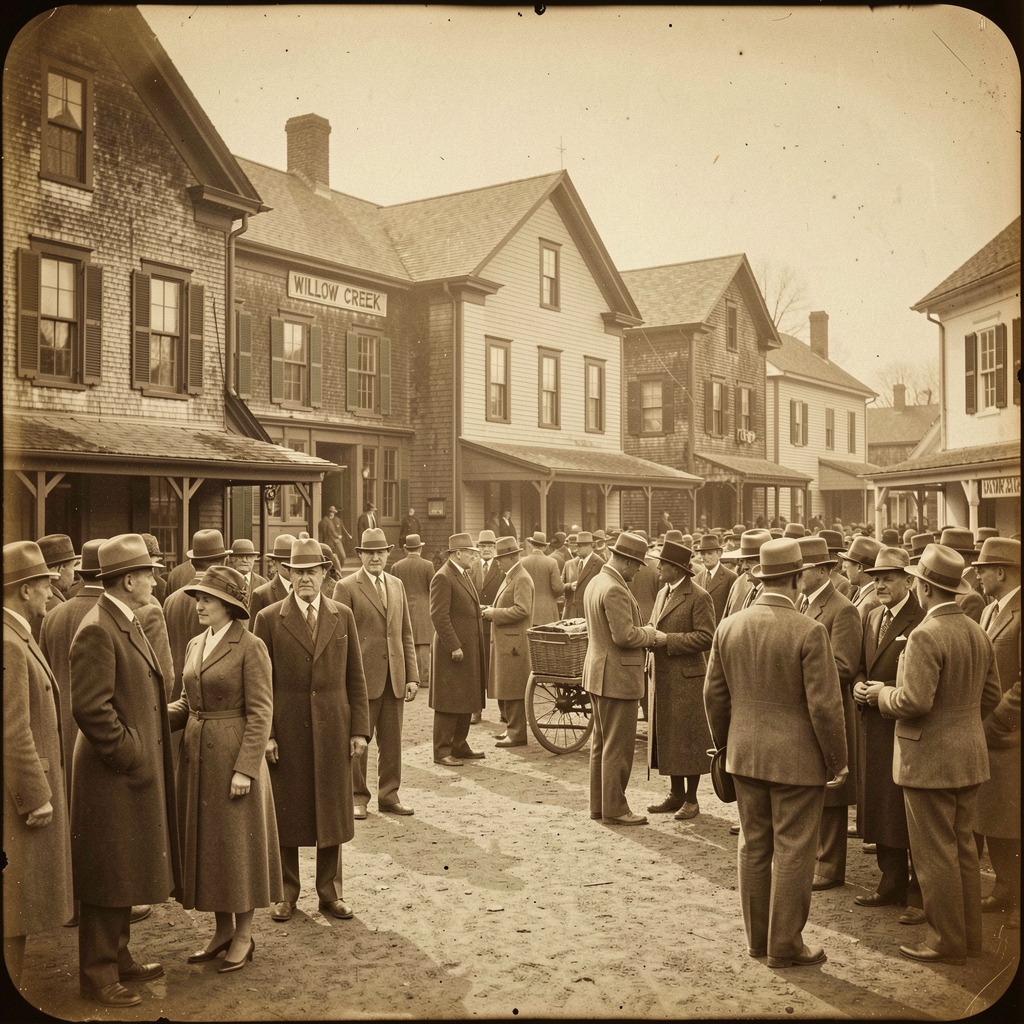
WILLOW CREEK — The collapse of the New York stock market last week has been received in Willow Creek with a mixture of concern and detachment — concern for the families who have investments in banks and railroads, and detachment born of the fact that most residents of this mill town have never owned a share of stock in their lives.
The Gazette has learned that at least three local families had significant holdings in the Bangor Savings Bank’s investment trust, which was heavily exposed to the now-collapsed market. One family, which asked not to be named, has reportedly lost the entirety of a $4,000 nest egg accumulated over twenty years of mill work.
“We did not speculate,” the husband told the Gazette in a quiet interview. “We saved. We put our money in what we thought was a safe bank, and the bank put it in the market. We did not know that was happening until last week.”
The mill, which employs approximately 130 workers, continues to operate at normal capacity. Mill manager Frank Bouchard confirmed that no layoffs are planned in the near term, though he acknowledged that the company is watching developments in New York with “close attention.”
“Our customers are building contractors in New England,” Bouchard said. “If the banks stop lending for construction, our orders will stop too. That is the connection between Wall Street and Willow Creek, and it is a direct one.”
Arthur Whitcomb, the Gazette’s editor, addresses the crash in a front-page editorial that strikes a note of cautious warning:
“The prosperity of the past decade, built on borrowed money and inflated stock values, has come to its natural end. The question now is whether the underlying economy — the farms, the mills, the railroads that produce real goods — can sustain themselves without the artificial support of speculation. In Willow Creek, we have never relied on speculation. We rely on the river, the forest, and the labor of our hands. Those things have not changed. But they will be tested in the months ahead.”
Seamus O’Donnell, at the General Store, reports that business has not yet been affected. “People still need flour and sugar,” he said. “They still need coffee. If the crash means anything in Willow Creek, we will not feel it for six months to a year. And by then, perhaps the worst will be over.”
That remains, in the Gazette’s view, an optimistic assessment.