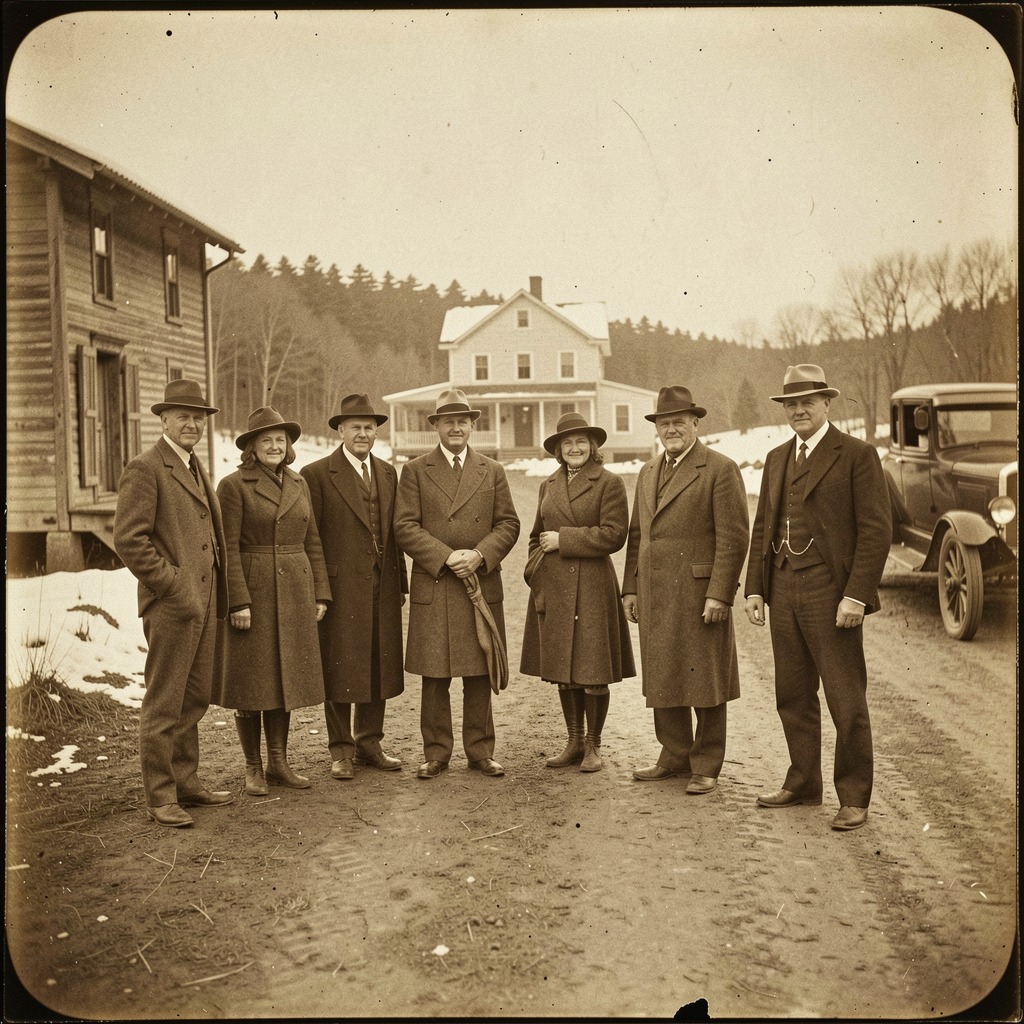
WILLOW CREEK — Albert Boucher, a 47-year-old mill hand who has worked on the Willow River for more than two decades, was declared the winner of the first Willow Creek Ice-Out competition yesterday, when the ice on Homan’s Hole cleared at 11:52 AM — within five minutes of his prediction of 11:47 AM.
The informal competition, which grew out of an idle wager among mill workers idled by a logjam at Thorne’s Bend, drew twenty-three entrants, each contributing one dollar to the pot. Boucher’s winnings amount to twenty-three dollars — roughly a week’s pay for a mill worker.
Boucher, who is the great-uncle of the modern Boucher family that operates the Irving station on Route 11, attributed his victory to years of observing the pond’s behavior. “I have been fishing this pond since I was a boy,” he said. “I know how the ice sets and how it releases. The north end clears first, always. The south end, where the mill race draws water, can hold ice for another day or more.”
The competition’s method was simple: a flour-barrel buoy anchored in the deepest part of the pond served as the marker. When the buoy was free to drift with the current, the ice was declared out. Ezra Homan, Elias’s son, served as the unofficial observer, standing at the pond’s edge with a pocket watch borrowed from the mill foreman.
“At 11:47, the buoy was still held fast,” Homan reported. “I called the time to the men, and we watched. Five minutes later, a crack ran across the ice from the north shore to the buoy, and within another minute, the buoy was drifting. I called the time at 11:52, and that was that.”
Boucher, who had been among the loudest proponents of moving the wager from the river to the pond, accepted his winnings with characteristic modesty. “It is not a thing to be proud of, predicting the weather,” he said. “It is a thing to be lucky at. And I was lucky.”
The men have already begun discussing whether to hold the competition again next year. A few have suggested formalizing the rules, establishing a fixed entry fee, and perhaps — though this is considered unlikely — allowing women to enter.
“I see no reason why it should not continue,” said Harold Fisher, the mill foreman. “It gives the men something to look forward to in the worst weeks of late winter. And it costs them nothing more than they would lose on a card game.”